
Costly Tax Mistakes Property Owners Need To Avoid in 2026
Disclaimer: This article is for general informational purposes only and does not constitute legal or financial advice. Property tax rules vary by county. Consult a licensed Florida tax professional or your county property appraiser for guidance specific to your situation.
Florida property owners can lower their tax bill significantly by claiming the homestead exemption, protecting their Save Our Homes benefit, and reviewing their TRIM notice every year. The biggest mistakes are missing the March 1 filing deadline, failing to apply for portability when moving, ignoring an inflated assessment, and assuming extra exemptions apply automatically. For many Florida homeowners, these errors can cost hundreds or even thousands of dollars over time.
Why Florida Property Taxes Trip Up Even Savvy Property Owners
You bought the home. You make the mortgage payment. You assume the tax side is already handled.
That is where many Florida property owners get caught.
Florida’s property tax system includes strong protections for primary residences, but those protections do not always activate on their own. Deadlines expire. Separate forms get missed. Assessment notices get opened too late. By the time an owner realizes what happened, the savings may already be gone for that year.
This guide explains the most common Florida property tax mistakes, what the rules mean in plain English, and what to do instead.
Looking for related help? See our Florida first-time homebuyer programs and mortgage options, how property taxes affect your mortgage escrow in Florida, and understanding closing costs for Florida home buyers.
Quick Start: Pick Your Path
- Just bought your first Florida home? Start with the homestead exemption section.
- Moving from one Florida home to another? Jump to portability.
- Received your TRIM notice? Read the assessment appeal section.
- Senior, veteran, or person with a disability? Check the additional exemptions section.
- Renting out part or all of your home? Review the rental rule carefully.
What is the Florida homestead exemption, and who qualifies?
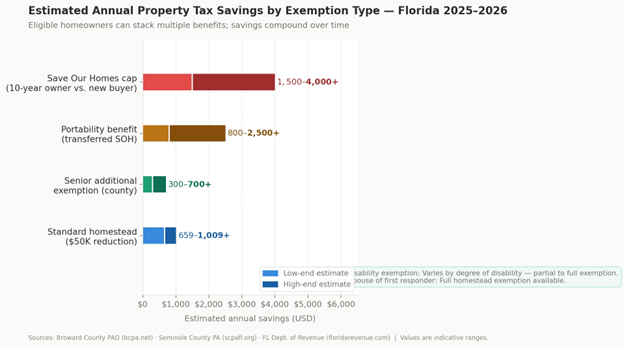
The Florida homestead exemption can reduce the taxable value of a primary residence by as much as $50,000. As the Florida Department of Revenue explains, when someone owns property and makes it their permanent residence, the property may qualify for a homestead exemption that decreases taxable value by up to that amount.
The state’s PT-113 homestead guide explains how the exemption works:
- the first $25,000 applies to all property taxes, including school taxes
- the additional amount applies to assessed value above $50,000 and only to non-school taxes
To qualify, the property generally must be your permanent residence as of January 1, and you must apply through the county property appraiser.
The deadline matters. Palm Beach County’s homestead exemption page says applications must be eligible as of January 1 and submitted by March 1 of the year the benefit will apply.
Mistake #1: Missing the March 1 deadline. If you miss it, you may lose the exemption for that tax year and wait another full cycle before seeing the savings.
Key takeaway: For Florida property owners, homestead is often the first and most valuable tax benefit to lock in.
What is Save Our Homes, and why does it matter?
Save Our Homes is one of the most important protections available to Florida homeowners with a homestead property.
The Florida Department of Revenue states that a homestead exemption qualifies the home for the Save Our Homes assessment limitation. In plain language, that means your assessed value may rise more slowly than the market value of your home.
Brevard County’s assessment cap guidance explains the practical difference between the homestead cap and the non-homestead cap. It notes that non-homestead real property cannot increase by more than 10% over the prior year’s assessed value, while homesteaded property receives the stronger Save Our Homes protection.
That gap can become very valuable over time. If your neighborhood rises quickly in price, your market value may jump much faster than your taxable value.
Mistake #2: Assuming the cap protects every property you own. It does not. The stronger Save Our Homes protection is tied to homesteaded property, not rentals or vacation homes.
Florida homestead portability: the savings many property owners leave behind
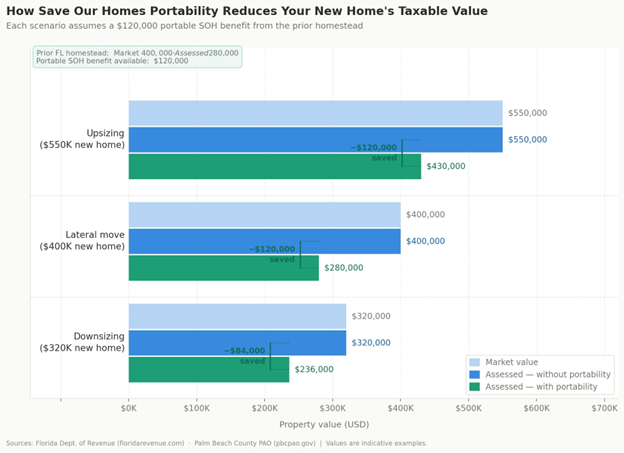
When Florida property owners sell one homesteaded home and buy another in the state, they may be able to transfer all or part of their accumulated Save Our Homes benefit.
This is called portability.
Palm Beach County’s portability page says Florida’s Save Our Homes provision allows owners to transfer all or a significant portion of that tax benefit, up to $500,000, from one qualifying Florida homestead to another.
Jacksonville’s property appraiser portability guidance adds that you may transfer the benefit if you had the homestead exemption on your old home in one of the three tax roll years preceding the year you establish the new homestead.
This is where many movers lose money. They know to file for the new homestead, but they forget portability is its own step.
Mistake #3: Missing the portability window. The timing rules are strict enough that delaying a new homestead can cost you the transfer.
Mistake #4: Filing for homestead but forgetting the separate portability form. A homestead application does not automatically file portability for you.
Decision checkpoint: If you are moving from one Florida primary residence to another, ask your county property appraiser about portability at the same time you file for homestead.
 How to read your TRIM notice, and why ignoring it can be expensive
A TRIM notice is Florida’s annual notice of proposed property taxes. It typically shows your market value, assessed value, exemptions, and estimated tax bill.
Florida’s Value Adjustment Board taxpayer guide says you must file an assessment appeal within 25 days after the property appraiser mails your TRIM notice. That deadline is one of the most important dates in the property tax calendar.
Many property owners make the mistake of treating the TRIM notice like junk mail or assuming the value is final.
It is not.
The Florida Department of Revenue’s VAB guide outlines the formal appeal process, while county offices can often discuss issues informally before a petition is filed. That gives owners a chance to question an assessment that may not reflect current property conditions or comparable local sales.
Mistake #5: Never checking whether your proposed market value looks reasonable. If the value is too high and you miss the deadline, the assessment usually stands for that year.
Additional exemptions Florida property owners often miss
The standard homestead exemption is not the only relief available.
The Florida Department of Revenue exemptions page lists additional benefits for:
- senior citizens
- veterans and active-duty military members
- property owners with disabilities
- disabled first responders
- surviving spouses in qualifying cases
- certain specialized property uses
For example, the department links to separate taxpayer guides for people 65 or older, veterans, and other special situations.
Mistake #6: Assuming extra exemptions apply automatically. Many do not. They may require separate applications, supporting documents, or recurring income verification.
 Renting your homestead: the rule that catches owners off guard
This is one of the most overlooked problems for Florida property owners who relocate temporarily, become snowbirds, or start renting a home they once lived in full-time.
Palm Beach County’s homestead exemption guidance says owners must file a new application if they move or change the manner in which title is held on an existing homestead. More broadly, if the property is no longer your true permanent residence, your exemption may no longer fit.
That means a homestead should not be treated like a set-it-and-forget-it status.
Mistake #7: Changing how the property is used without checking the homestead impact first. Renting out the home, moving your primary residence elsewhere, or changing title structure can put the exemption at risk.
Florida property tax benefit comparison
| Feature | Homestead Exemption | Save Our Homes | Portability |
| What it does | Reduces taxable value | Limits assessed value growth on homestead property | Transfers Save Our Homes benefit to a new homestead |
| Who qualifies | Florida residents using the home as a permanent residence | Homesteaded properties | Owners moving from one Florida homestead to another |
| Key deadline | March 1 | Automatic after qualification | Usually filed with the new homestead application |
| Potential value | Up to $50,000 reduction in taxable value | Long-term tax growth protection | Up to $500,000 in transferred benefit |
Step-by-step: how property owners can protect their Florida tax benefits
- Close and establish residency before January 1 if you want the next tax year’s homestead benefit.
- File for homestead by March 1 with your county property appraiser.
- If you moved from another Florida homestead, ask about portability immediately.
- Review your TRIM notice every August instead of filing it away.
- If the value seems too high, act quickly because appeal deadlines move fast.
- Check for senior, veteran, disability, or other special exemptions every year.
- Notify the property appraiser if ownership, title, or use changes.
Common mistakes: quick reference
- Missing the March 1 homestead deadline
- Forgetting portability when moving
- Ignoring the TRIM notice
- Assuming all exemptions are automatic
- Treating a rental or second home like a homestead
- Failing to report title or use changes
- Waiting too long to challenge an inflated assessment
Frequently asked questions
What is the Florida homestead exemption?
It is a property tax benefit that can reduce the taxable value of a qualifying primary residence by up to $50,000.
When is the homestead exemption deadline in Florida?
For most Florida property owners, the filing deadline is March 1 of the tax year in which the exemption will apply.
What is Save Our Homes?
It is the assessment limitation that applies to homesteaded property and helps hold down taxable value growth over time.
What is portability in Florida?
Portability allows eligible property owners to transfer all or part of their Save Our Homes benefit from one Florida homestead to another.
What is a TRIM notice?
It is the annual notice of proposed property taxes showing your value, exemptions, and estimated bill. It is also your warning window if something looks wrong.
Can I lose my homestead exemption?
Yes. If the property is no longer your permanent residence, or if ownership or use changes in ways that affect eligibility, the exemption may be lost.
Do seniors and veterans get extra exemptions in Florida?
They may. Florida offers additional benefits for some seniors, veterans, and other qualifying property owners, but the eligibility rules vary.
Putting it all together
Florida’s property tax system can reward owners who understand how it works. The homestead exemption, Save Our Homes protection, portability, and appeal rights can all reduce the long-term cost of ownership.
But those benefits depend on action. A missed deadline, an ignored notice, or a forgotten portability form can cost a Florida homeowner real money year after year.
If you are unsure whether your tax status, homestead filing, or escrow picture is set up properly, speak with a knowledgeable Florida mortgage or real estate professional before the next deadline passes.
Ready to review how your Florida property taxes fit into your overall mortgage picture? Contact our team for a no-obligation conversation with an experienced Florida mortgage professional.
Reminder: This article provides general guidance only. Property tax rules, deadlines, and exemption amounts vary by county and may change. Verify current requirements with your county property appraiser or a licensed Florida tax professional before making decisions.
Sources & References
- Florida Department of Revenue — Property Tax Exemptions: https://floridarevenue.com/property/Pages/Taxpayers_Exemptions.aspx
- Florida DOR — Homestead Exemption Guide (PT-113): https://floridarevenue.com/property/documents/pt113.pdf
- Florida DOR — Save Our Homes Guide (PT-112): https://floridarevenue.com/property/Documents/pt112.pdf
- Florida DOR — Taxpayer Guide to VAB Petitions (PT-101): https://floridarevenue.com/property/documents/pt101.pdf
- Broward County Property Appraiser — Homestead: https://bcpa.net/homestead.asp
- Palm Beach County PAO — Homestead Exemption: https://pbcpao.gov/homestead-exemption.htm
- Palm Beach County PAO — Portability: https://pbcpao.gov/portability.htm
- Manatee County PAO — Portability: https://www.manateepao.gov/definitions/portability-of-save-our-homes/
- Brevard County PAO — Assessment Caps: https://www.bcpao.us/Caps.aspx?t=1.1
- Seminole County PA — Exemptions: https://www.scpafl.org/information/exemptions
- Jacksonville Property Appraiser — Portability: https://www.jacksonville.gov/departments/property-appraiser/portability
- com — Florida TRIM Notice Explained: https://www.propertyexemption.com/property-tax/trim-notice/
- com — How to Appeal Property Taxes in Florida: https://www.propertyexemption.com/guides/how-to-appeal-property-taxes-florida/
- com — Save Our Homes Portability Calculator: https://www.propertyexemption.com/save-our-homes/
- Moffa Tax Law — Florida 2026 Property Tax Relief Proposals: https://moffataxlaw.com/floridas-2026-property-tax-relief-proposals-complete-guide-to-homestead-changes-soh-caps-and-assessment-limits/